


B.Sc. Nursing
- Home
- /
- B.Sc. Nursing
- program outline
B.Sc. Nursing
- Duration: 4 years divided into 8 semesters (two per academic year).
The syllabus and exams are regulated as per RGUHS guidelines.
What You Study (Semester-Wise )
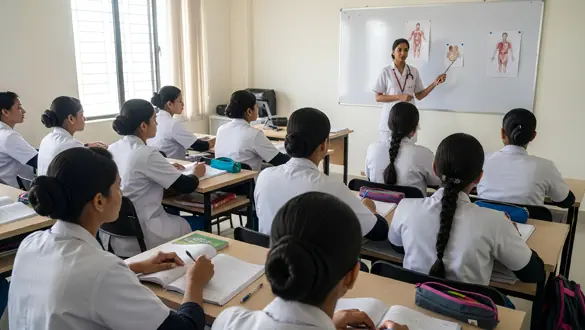
The nursing curriculum is a blend of theory, practical labs, clinical training, and field work.
Basic Eligibility for B.Sc Nursing Admission
Candidates must:
Educational Qualification
Must have completed 10+2, PUC, or equivalent from a recognised board with the following subjects:
- Physics, Chemistry, Biology (PCB) as science subjects
- English as a subject and passed it individually
Minimum marks in these subjects together:
- General category: 45% aggregate in PCB
- Reserved categories (SC/ST/OBC – Karnataka students): 40% aggregate in PCB
Age Requirement
- Minimum age: 17 years by 31st December of the year of admission.
Entrance & Admission Process
- Admission for B.Sc Nursing in Karnataka is through the Karnataka Common Entrance Test (CET/KCET) conducted by Karnataka Examinations Authority (KEA).
- Student must register and appear in the CET for science subjects (PCB), and counselling is based on your rank and eligibility.
- 20% students can be admitted on merit of 10+2 marks through institutional selection.
Get Admission Guidance
Share Your Details
Here are 10 Key Reasons to Choose Nursing Profession
1. Recession Proof Stability
Healthcare is always essential; nursing provides unmatched job security even during economic downturns.
2. High Global Demand
Your Indian nursing degree is a "global passport," with massive recruitment drives from the UK, USA, Canada, and the Gulf.
3. Attractive Government Pay
Central government roles (like AIIMS) offer high starting salaries (₹75,000+) along with pensions and housing allowances.
4. Diverse Specializations
You can move beyond general care into high-tech fields like ICU, Cardiac, Oncology, or even Forensic nursing.
5. Rapid Career Growth
With experience or further education (M.Sc. Nursing), you can quickly transition into management, research, or teaching roles.
6. Work Life Flexibility
Shift-based work often allows for flexible scheduling, such as working longer hours over fewer days to have more time off.
7. Constant Learning
Medicine is always evolving; you’ll work with the latest medical technology and life-saving treatments every day.
8. Respected Social Status
Nurses are consistently ranked among the most trusted and ethical professionals in society.
9. Versatile Work Settings
You aren't limited to hospitals; you can work in schools, corporate offices, the military, or even as a flight nurse.
10. Profound Personal Fulfillment
Very few jobs offer the direct emotional reward of saving lives and being the primary source of comfort for patients.
Semesters 1–2 (1st Year)
Foundation & Basics
Basic Sciences:
- Applied Anatomy, Applied Physiology
- Biochemistry, Nutrition & Dietetics
- Behavioral & Social Sciences:
- Psychology, Sociology, Communicative English
Nursing Fundamentals:
- Basic patient care, nursing principles & early clinical skills.
- Practical labs and simulations included.
Semesters 3–4 (2nd Year)
Core Nursing Sciences
- Applied Microbiology & Infection Contro
- Pharmacology I & II, Pathology & Genetics
- Adult Health (Medical-Surgical) Nursing I & II
- Professional Ethics, bioethics and educational technology.
- Practical postings and clinical rotations begin.
Semesters 5–6 (3rd Year)
Specialized Nursing
- Child Health Nursing I & II
- Mental Health Nursing I & II
- Midwifery / Obstetrics & Gynecology (OBG) Nursing I
- Nursing Management & Leadership
- Community Health Nursing I & II
- Practical skills in maternal and child care, community programs, and mental health.
Semesters 7–8 (4th Year)
Advanced Practice & Internship
- Senior specialty subjects:
- Advanced Community Health Nursing
- Advanced midwifery and clinical care specialties
- Research & Education:
- Nursing Research & Statistics
- Educational Technology / Nursing Education
- Extensive hands-on training in hospitals and community health settings (usually in Semester-VIII).
Future Scope in Nursing
1. Growing Job Opportunities
The demand for nurses is steadily increasing due to population growth and rising healthcare needs, ensuring strong job security.
2. Higher Education and Advanced Practice
Nurses can pursue advanced degrees to become nurse practitioners, clinical specialists, or nurse anesthetists.
3. Specialization Options
There are many specialties such as pediatric nursing, critical care, oncology, psychiatric nursing, and community health.
4. Global Employment Opportunities
Nursing qualifications are recognized worldwide, offering chances to work in different countries.
5. Technological Advancement
Nurses are trained to use modern medical equipment, electronic health records, and telemedicine systems.
6. Leadership Roles
Experienced nurses can become nurse managers, supervisors, or hospital administrators.
7. Research and Academic Careers
Nurses can enter research fields or become educators in nursing colleges and universities.
8. Community and Public Health Roles
Nurses play an important role in community health programs, vaccination drives, and health awareness campaigns.
9. Flexible Work Options
Nursing offers flexible schedules, part-time roles, and opportunities in various healthcare settings.
10. Personal and Professional Growth
Nursing promotes continuous learning, skill development, and personal satisfaction by helping others
Scholarship and financial aid
Post Matric Scholarship (State Scholarship Portal)
- Supports students (including nursing) from SC/ST/OBC/minority communities.
- Application is through the Karnataka State Scholarship Portal (SSP).
National Scholarship Schemes
- These are central government or national portal scholarships open to nursing students across India (apply via scholarships.gov.in):
College Specific / Management Scholarships
- Additional scholarships on as per college management terms such as:
- Merit-based discounts in tuition fee
- Need-based financial support to rank students.
- Awards for academic excellence or co-curricular achievement
Frequently Asked Questions (FAQs)
Who regulates B.Sc Nursing education in Karnataka?
It is regulated by the Rajiv Gandhi University of Health Sciences and the Karnataka State Nursing Council.
What is the duration of B.Sc Nursing?
The course duration is 4 years (8 semesters) including internship.
What is the eligibility for B.Sc Nursing admission?
10+2 with Physics, Chemistry, Biology, and English with 45% minimum marks.
Is CET required for B.Sc Nursing in Karnataka?
Yes CET is required for admission for nursing college in karnataka.
Can B.Sc Nursing students apply for government jobs?
Yes, after registration with the State Nursing Council.
Can a student carry over failed subjects to the next year?
Yes, but promotion rules depend on RGUHS,KNC and INC norms.
Is clinical attendance separate from theory attendance?
Yes, separate minimum 80 % attendance is required for theory and clinical.
Are research projects compulsory in B.Sc Nursing?
Yes, a research project is mandatory in the final year.
Can students get scholarships in Karnataka?
Yes, eligible students can apply for state and central government scholarships.
Can B.Sc Nursing students appear for competitive exams?
Yes, graduates can apply for government recruitment and other competitive exams.
Is medical fitness required at the time of admission?
Yes, a medical fitness certificate is required.
What is the maximum duration to complete B.Sc Nursing?
Students must complete the course within the time limit prescribed by the university.
Is English compulsory in B.Sc Nursing?
Yes, English is a compulsory as mode of instruction is English language.
Frequently Asked Questions (FAQs)
Who regulates B.Sc Nursing education in Karnataka?
It is regulated by the Rajiv Gandhi University of Health Sciences and the Karnataka State Nursing Council.
What is the duration of B.Sc Nursing?
The course duration is 4 years (8 semesters) including internship.
What is the eligibility for B.Sc Nursing admission?
10+2 with Physics, Chemistry, Biology, and English with 45% minimum marks.
Is CET required for B.Sc Nursing in Karnataka?
Yes CET is required for admission for nursing college in karnataka.
Can B.Sc Nursing students apply for government jobs?
Yes, after registration with the State Nursing Council.
What are higher study options after B.Sc Nursing?
M.Sc Nursing, MPH, MBA in Hospital Administration, or other postgraduate courses.
Can B.Sc Nursing graduates work abroad?
Yes, after clearing required international licensing exams eg: IELTS,OET etc.
Can a student carry over failed subjects to the next year?
Yes, but promotion rules depend on RGUHS,KNC and INC norms.
Is clinical attendance separate from theory attendance?
Yes, separate minimum 80 % attendance is required for theory and clinical.
Are research projects compulsory in B.Sc Nursing?
Yes, a research project is mandatory in the final year.
Can students get scholarships in Karnataka?
Yes, eligible students can apply for state and central government scholarships.
Can B.Sc Nursing students appear for competitive exams?
Yes, graduates can apply for government recruitment and other competitive exams.
Is medical fitness required at the time of admission?
Yes, a medical fitness certificate is required.
What is the maximum duration to complete B.Sc Nursing?
Students must complete the course within the time limit prescribed by the university.
Is English compulsory in B.Sc Nursing?
Yes, English is a compulsory as mode of instruction is English language.
- TESTIMONIALS
Student Testimonials
Trusted by students, our nursing college delivers quality education, practical training, a safe campus environment, and a strong career foundation.
My nursing education provided me with a strong foundation in patient care, clinical procedures, and healthcare ethics. Clinical postings helped me understand the importance of empathy, teamwork, and dedication in delivering quality nursing care.
2021-2026
During my nursing training, I gained valuable knowledge in patient assessment, medication administration, and emergency care. Each clinical experience strengthened my confidence and professional Skills.

2021-2026
My academic and clinical experiences helped me develop the skills needed for effective patient care. Working closely with patients taught me patience, responsibility, and the true meaning of service in healthcare.
2021-2026
The nursing program helped me build both technical skills and professional confidence. Clinical exposure in different departments enhanced my ability to provide safe and efficient patient care.

2021-2026
My journey in nursing education helped me grow academically and personally. Through patient care and teamwork in hospitals, I developed a strong sense of responsibility and dedication

2021-2026
Clinical training allowed me to apply theoretical knowledge in real-life healthcare situations. It strengthened my decision-making skills and prepared me to handle patient care with confidence.

2021-2026
My nursing education provided exposure to various hospital departments and patient conditions. These experiences helped me develop strong clinical skills and a caring attitude towards patients.
2021-2026
The nursing program strengthened my knowledge of healthcare practices and patient management. Working in clinical settings taught me the value of teamwork and compassionate care.
Ms. ARATI .D
2021-2026